
Home
/Blog
/Mattress Topper vs Protector vs Pad 2026: Honest Comparison
Mattress Topper vs Protector vs Pad 2026: Honest Comparison
Comparing mattress topper, mattress protector, and mattress pad, because everyone gets this wrong. A topper changes feel. A protector stops damage. A pad does both badly. We tell you exactly which one to buy and when to use all three.
 Neha Madhavi
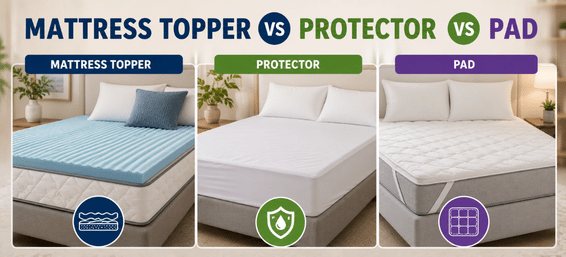
A mattress topper changes how your bed feels. It is designed to make firm mattress softer, hot mattress cooler, or an aging mattress comfortable again. A mattress protector doesn't change anything about how your bed feels. It exists to stop stains, spills, and dust reaching your mattress. A mattress pad sits in the middle, provides minimal softness, and offers partial protection.
A mattress topper changes how your bed feels. It is designed to make firm mattress softer, hot mattress cooler, or an aging mattress comfortable again. A mattress protector doesn't change anything about how your bed feels. It exists to stop stains, spills, and dust reaching your mattress. A mattress pad sits in the middle, provides minimal softness, and offers partial protection.
Comparing Mattress Topper vs Mattress Protector vs Mattress Pad 2026: Identify Which Do You Actually Need?
Do I need a mattress topper, mattress protector, or mattress pad? Can one of them do the job of others?
These questions are easy to get stuck on when you're looking for the best companion for your mattress. You might be thinking mattress toppers, protectors, and pads do the same job when you put them on a mattress. But let me tell you one thing: even if three of them sit on top of your mattress, everyone solves very different problems.
A mattress topper changes how your mattress feels. It can add softness, pressure relief, or cooling, depending on the material and thickness. A mattress protector is there to protect the mattress from spills, sweat, stains, allergens, and everyday messes without changing its feel. And finally, a mattress pad adds a small amount of cushioning and basic protection.
The most confusing part is choosing the one that actually makes sense for your mattress. So, if your soul is confused finding the best companion for your mattress, this article will help you figure out things.
In this article, we'll compare comfort impact, protection, thickness, cost, lifespan, and limitations of toppers, protectors, and pads. We've also explained when to combine a topper and protector, how to layer them correctly, and when buying a pad is not worth the money.
So, if you're ready to find out which one suits your needs and mattress, let's get started.
A Quick Comparison for Easy Understanding
If you're confused, start with the problem you're trying to solve. Most of the time your problem tells you what to buy rather than unnecessarily comparing materials, brands, or thread counts.
If your mattress is too firm, too hot, or uncomfortable, choose a mattress topper.
A topper is designed to change the feel of your mattress. It can add cushioning, pressure relief, or cooling, depending on type of topper you choose.
If you're mainly worried about spills, sweat, stains, allergens, or protecting your mattress, choose a mattress protector.
A protector can not make your bed soft or firm. It is made to create a barrier between your mattress and everyday messes.
If you want a little extra cushioning plus some protection, choose a mattress pad.
A pad can work when your mattress already feels good and you only want to boost a bit of your comfort. A mattress pad won't give you the same comfort change as a topper or the same protection as a waterproof protector.
If your mattress has a noticeable sag or dip, neither the topper, pad, nor protector can fix it.
A topper can improve the surface feel of a mattress, but it cannot repair a damaged support core. If your mattress has visible sagging, putting a topper on it will only hide the problem for a while. So, you need to consider replacing the mattress instead.
Our Thought: Simply saying, a topper changes the mattress feel, a protector protects the mattress, and a pad will improve a bit of comfort. Don't buy one just because it sounds like the closest match to what you already have. First identify what's wrong with your current mattress. If the problem is comfort, look for a topper. If the problem is protection, get a protector. And if the mattress is sagging or failing structurally, save that money to replace the mattress.
Why Are Mattress Toppers, Pads, & Protectors Constantly Confused?
Part of the confusion comes from the names. A mattress pad is a general term used for almost anything placed over the mattress. Many times shoppers search for pads when they actually need a protector or a topper.
The other problem is that the product lines overlap. Some pads now include waterproof layers, while some protectors add light cushioning. This makes shopping harder because two products look similar while they solve very different problems.
Our Thought: Don't shop by seeing the word "pad." Shop by the problem you want to solve. If you want to change how your mattress feels, choose a topper. If you want to keep liquid and everyday messes away from your mattress, choose a protector. If you only want a small comfort boost with some protection, a pad can help you.
Let's check out in detail when each one of them is suitable for you.
What Is a Mattress Topper? (And When You Genuinely Need One)
If you want to change how your mattress feels, only a mattress topper can help you. You can keep it top of the mattress to add another layer of cushioning, pressure relief, or support. Unlike a protector, which will feel almost invisible, a topper is made to provide comfort.
Topper is useful when your mattress is structurally sound but its surface won't feel right. Maybe your mattress is too firm, causing shoulder and hip soreness, or you want to sleep cooler without replacing the whole mattress.
Thickness Of a Topper Matters More Than You Might Think:
Material matters, but don't overlook thickness. A thick topper generally gives you more comfort because there is simply more material between you and the mattress. Toppers come in around 2 to 4-inch range. However, thinner and thicker options are also available.
Let's check out what each sized mattress will make you feel like,
1.5 inches: It'll give you a lighter adjustment. For instance, Saatva's High-Density Foam Topper uses a 1.5-inch layer of high-density foam. It is designed to add cushioning and support without completely changing the mattress underneath. It can cost you around $245 for a queen size topper.
2 inches: It'll provide you a more noticeable comfort layer. For instance, Layla's Copper Infused Memory Foam Topper which is 2 inches thick. This makes it a middle-ground choice if you want more pressure relief without adding a very thick layer. Layla toppers offers a 30-night trial for this topper.
3 inches: It can provide you a major feel change. For instance, Saatva's Graphite Memory Foam Topper. It is 3 inches thick and uses graphite-infused memory foam for contouring and cooling. It's queen size toppers can cost you around $305.
So, if your mattress is already doing its job fine, a thin topper can solve your problem. If your mattress feels significantly too firm or you need deeper pressure relief, a thick topper will help you get comfortable sleep.
What Can a Mattress Topper Actually Fix?
A topper can extend the life of your mattress if it's in good condition but has lost some surface comfort.
🟢 If your mattress is too firm, a soft topper can add a cushioning layer to your mattress. It is useful when your mattress is still supportive and in good condition.
🟢 If you sleep hot, some toppers are designed with cooling materials or more breathable constructions. For instance, Saatva Graphite topper combines 3-inch memory foam with graphite infusion and a breathable cotton cover.
🟢 If your shoulders or hips feel pressure, a contouring foam topper will be the suitable choice. Because it'll help your body areas sink into the topper and give you a comfortable feel. This is one reason thicker memory foam toppers can be useful for side sleepers.
🟢 If you've decided to buy a mattress topper, here you can explore the best mattress toppers by sleeping position.
What a Mattress Topper Cannot Fix:
A topper can change surface comfort. It cannot repair a damaged mattress.
🔴 If your mattress is sagged, a topper won't restore the support. A topper will solve the problem of uneven surfaces, but the sagging will remain unchanged.
🔴 That's why you should check the mattress itself before buying a topper. If the bed is flat and structurally sound but feels firm or uncomfortable, a topper can be a smart upgrade.
Our Top Mattress Topper Picks:
| What you need | Our pick | Thickness | Current queen price |
| Cooling + memory foam feel | Saatva Graphite Memory Foam Topper | 3" | From Around $305 |
| Long-lasting, responsive feel | Saatva Natural Latex Topper | 1.5" | From Around $255 |
| Subtle comfort upgrade | Saatva High-Density Foam Topper | 1.5" | From Around $245 |
| Pressure relief without a very thick topper | Layla Copper Infused Memory Foam Topper | 2" | From around $254 |
Don't judge a topper only by its price or thickness. Pay for the amount that'll improve your sleep. If your mattress is mostly comfortable, a $245 1.5-inch topper will be fine rather than spending on a thick cooling topper. If you're dealing with serious firmness or pressure issues, spending more on a thick topper will be worth it.
Also, check for mattress topper coupons before buying. For instance, if you're buying Saatva High-Density Foam Topper or Graphite Topper, using an active Saatva topper coupon code will help you get up to $100 off. Active coupons can help you make the mattress topper purchase more affordable for you.
Our Thought: A topper will be the best choice when the mattress is still in good condition. With a topper, you are not repairing the bed, you are changing its surface for more comfort.
The biggest mistake is choosing a topper based on material alone. So, first identify what you need, then choose the right material topper depending on your needs.
What Is a Mattress Protector? (And Why Everyone Should Buy One)
A mattress protector has one simple job, to protect your mattress from damage. Protector will protect your mattress from spills, sweat, stains, dirt, and allergens that come with everyday use.
Unlike a topper, a protector is not designed to change the mattress's comfort. A protector helps to protect your mattress from surprise events that can damage the mattress.
Why Almost Everyone Should Own a Mattress Protector:
To be honest, a sheet can not protect your mattress from everything. You can wash your sheets regularly, but you can't throw them in the washing machine. Sweat, skin cells, accidental spills, pet accidents, and other moisture can eventually reach the mattress.
For instance, if you spend $1,000 or more on a mattress, spending a small amount on protector is an easy option to reduce the risk of damage.
Mattress Protector: The Cheap Layer That Protects an Expensive Mattress
A basic protector can cost roughly $30 to $80. While a good quality mattress can cost you around $300 or even $1000+.
This price difference makes the protector the best value for your money. You are spending a small amount of the mattress price to protect it from everyday damage.
The important thing is a protector guarantees the warranty of the mattress. It reduces the risk and protects both your mattress and its warranty.
Two Types of Mattress Protectors: Fitted vs Encasement
Not every protector gives you the same coverage. Here is what you need to know before buying a mattress protector.
| Type | Coverage | Best for | Typical price |
| Fitted protector | Top + sides | Most households and easy washing | $30–$60 |
| Encasement protector | Top + bottom + sides with a zip seal | Bed bug concerns and stronger allergen protection | $50–$100 |
A fitted protector works like a fitted sheet. It stretches around the mattress and protects the sleeping area and sides. For most people with babies, toddlers, or pets, this is the practical choice because it is easy to remove and wash.
An encasement protector surrounds the entire mattress and closes with a zipper. It makes more sense when you need full-coverage protection. It can help you protect your bed from bed bugs or other issues.
Don't buy encasement protectors only because "more coverage" sounds better. If you want protection from spills and everyday messes, a good fitted waterproof protector will be enough.
Who Should Definitely Use a Mattress Protector?
To be honest, a protector is beneficial for almost everyone. But if you fall in, following category, you should definitely buy a protector to avoid future expenses.
🟢 If you're a parent with young children, a waterproof protector will help you avoid spills, nighttime accidents, and moisture.
🟢 If you're someone with allergies, a fitted protector will keep you safe and hygeinic.
🟢 If you're a pet mom or dad, a washable protector will keep your mattress clean from fur, dander, and dirt.
🟢 If you are buying a new mattress, a protector will help you keep your new mattress as it is by avoiding accidents from day one.
🟢 If you prefer premium materials, trying Saatba Organic Mattress Pad will be worth it, because it is made with organic cotton. It is a
Our Thought: A mattress protector simply exists to protect your mattress from unexpected accidents. It cannot improve the mattress feel like toppers do. A topper solves a comfort problem, while a protector prevents a problem.
If your mattress is new, comfortable, and in good condition, buying a protector is a smart choice. The best protector is the one that protects the mattress without making you feel like you've added another layer to your bed.
What Is a Mattress Pad?
A mattress pad is like a middle choice between a protector and a topper. It usually adds a thin layer of quilted cushioning while providing basic protection. Some mattress pads are waterproof, while others are made to provide softness and comfort.
Mattress pads sound useful, but they create the biggest problem: a mattress pad can be too little for the job you're actually trying to solve.
What Does a Mattress Pad Actually Do?
Most mattress pads are thin, often around 1-2 inches thick. They can make your mattress feel a bit softer and give you a cushioning surface without changing the overall feel.
Some waterproof pads can protect your mattress from moisture. This makes pads more beneficial than a basic protector, but you need to check the product description first. A mattress pad is not automatically waterproof just because it offers some protection.
The Honest Problem With Mattress Pads:
The main problem with mattress pads is they try to do two jobs without being particularly good at either one.
- If your mattress is genuinely too firm or too soft, a quality topper will give you a thicker layer for comfort.
- If you want a noticeable comfort change, a topper makes more sense.
- If you want to protect your mattress from liquid, a waterproof protector will make more sense.
- And if you want to improve a bit of comfort with some basic protection, a mattress pad will make more sense.
The mattress pad isn't a bad choice. It's just easy to buy the wrong one because it sounds like it can replace both the topper and protector.
When Does a Mattress Pad Actually Make Sense?
🟢 If your mattress is already comfortable but you want a little extra cushioning, you would like some protection, and if you don't mind removing and washing the pad regularly. In this case, a waterproof mattress pad will be the best choice.
🟢 If you use both a mattress protector and a pad, it works differently from a topper. You can directly put the protector over mattress, place the pad above the protector, and then cover both with a fitted sheet.
This will provide protection to your mattress and give you a softer surface to sleep peacefully.
Our Thought: A mattress pad is the middle option for comfort and protection, but midway isn't always better. If you need more comfort, choose a topper without a second thought. If your main goal is to protect your mattress, buy a protector. When your mattress works fine and you want to add a layer of comfort plus protection, choosing a pad will be beneficial.
Comparing Mattress Topper, Pad, & Protector
In one line, a topper changes how your mattress feels, a pad will give you a bit of a comfort change, and a protector will simply protect your mattress.
This table will help you understand each one better.
| Features | Mattress Topper | Mattress Pad | Mattress Protector |
| Changes sleep feel? | ✅Significantly | ⚠️Minimally | ❌No |
| Primary purpose | Changes comfort and feel | Adds minor comfort + some protection | Protects the mattress |
| Typical thickness | About 2 to 4 inches | About 1 to 2 inches | Paper-thin to about 0.5 inch |
| Waterproof? | ❌ Most are not | ⚠️ Some are waterproof | ✅ Most dedicated protectors are |
| Fixes a sagging mattress? | ❌ No | ❌ No | ❌ No |
| Protects mattress warranty? | ❌ Not its purpose | ⚠️ Depends on construction | ✅ Helps reduce stain/liquid damage risk |
| Machine washable? | ❌ Usually not | ✅ Usually | ✅ Usually |
| Price range | $100–$450 | $30–$100 | $25–$80 |
| Lifespan | 3 to 5 years | 2 to 3 years | 1 to 3 years |
| Best for | Firmness, pressure relief, cooling, comfort changes | Mild cushioning + some protection | Spills, sweat, stains, allergens |
| Brand examples | Saatva, Layla Sleep | Saatva Organic Mattress Pad | Saatva Protector |
From table,
- If you want to change your mattress, start with a topper.
- If you want to protect your mattress, start with a protector.
- If you want a bit of cushioning and some protection, a pad will work fine.
- And if your mattress has a sagging issue, none of the three will fix it.
Our Thought: The easiest buying mistake is choosing the one depending only on price. A $40 pad may look like a better deal than a $200 topper, but they're not solving the same problem.
You better buy, depending on what you want to change. If you want to change comfort, fitness, pressure, or temperature, spend your money buying a quality topper. If nothing is wrong with your mattress and you want to keep it clean and protected, buying a cheaper protector will be a smart purchase.
Can You Use All Three (Mattress Topper, Protector & Pad) Together?
Yes, you can use a mattress topper, mattress pad, and mattress protector together. But you don't need all three.
If you want to protect the mattress while changing its feel, you will need a waterproof mattress protector + mattress topper. The protector keeps spills and moisture away from the mattress, while the topper changes the comfort level.
Here is how you can layer the mattress from bottom to top for the basic topper + protector setup.
1. Mattress (Your actual mattress sits at the bottom.)
↓
2. Mattress Protector (Put the waterproof protector directly over the mattress to stop spills, sweat, and other moisture from reaching the mattress.)
↓
3. Mattress Topper (Place the topper above the protector to change the feel of the bed.)
↓
4. Fitted Sheet (The fitted sheet goes over the mattress and topper together to help keep the layers in place.)
↓
5. Rest of Your Bedding (Add your usual sheets, duvet, blankets, and pillows.)
What If You Also Want a Mattress Pad?
You can add one, but ask yourself why first.
If you already have a topper for comfort and a protector for waterproofing, a pad will be an extra item.
If you do want to use a pad, the basic arrangement is:
Mattress → Protector → Topper → Pad → Fitted Sheet
Here, the protector protects the mattress, the topper changes the feel, and the pad adds a thin quilted surface layer.
But remember, adding more layers will also add height and make your bed feel uncomfortable.
Should the Protector Go Over or Under the Topper?
For protecting the mattress, you need to put the protector under the topper.
But if you also want to protect the topper from sweat, spills, and stains, you can place another washable protector over the topper and under the fitted sheet:
Mattress → Protector → Topper → Protector → Fitted Sheet
This setup gives you protection for both expensive layers. The bottom protector protects the mattress, while the upper protector protects the topper.
What Does the Full Setup Cost You?
| Item | Example price | Lifespan | Approx yearly cost |
| Mattress protector | $35–$60 | 2–3 years | $12–$30 |
| Saatva Graphite Topper | $295 | 3–5 years | $59–$98 |
| Extra-deep fitted sheets | $40–$80 | 2–3 years | $13–$40 |
| Estimated system cost/year | $84–$168 |
Our Thought: You won't get extra value simply by stacking every mattress accessory you can find. For most users, "mattress + waterproof protector + topper + fitted sheet" will be the perfect perfect. You need to add a pad. only when you have a specific reason for that extra layer.
And if you want to protect both mattress and topper, the two protectors make more sense. One protector goes under the topper to protect the mattress, and another goes above it to protect the topper.
What Each Product Protects (Including Your Mattress Warranty)
The three products don't protect the same thing. A mattress protector protects the mattress itself. A pad will give basic protection from spills. And a topper will help you protect your comfort, not your mattress.
Most people assume that a warranty covers anything that goes wrong. But mattress warranties usually have specific conditions, exclusions, and requirements.
Many mattress warranties exclude stains, liquid damage, or contamination from bodily fluids. That means a mattress warranty claim gets rejected because of the type of damage.
For instance, if you spend $1295 on a mattress with long-term warranty coverage, spending another $40 to $60 on a waterproof protector will be worth it. So, checking your mattress warranty before buying will be more beneficial.
What Does Each Product Actually Protect?
Product Protects mattress from spills? Protects mattress from everyday buildup? Protects topper? Changes comfort? Mattress topper ❌ No ❌ No ✅ Yes Mattress pad ⚠️ Only if waterproof ⚠️ Somewhat ❌ No ⚠️ Slightly Mattress protector ✅ Yes, if waterproof ✅ Yes ❌ Not when underneath ❌ No
If you're investing in a good mattress and a good topper, the protector is the inexpensive layer that protects both investments underneath.
Protection Costs Less Than Replacement:
Here's a simple way to look at the cost of protection.
| Mattress | Example price | Warranty value | Example protector cost | Protector as % of mattress price |
| Saatva Classic | $1,295 | Lifetime | $40 to $60 | 3 to 5% |
| Zinus Green Tea | $250 | 10 years | $25 to $40 | 10 to 16% |
| EGO Home Hybrid | $400 | 10 years | $30 to $50 | 7 to 12% |
From the table, we can say that by adding a protector, you're adding an inexpensive barrier to your mattress, which can cost you hundreds of dollars.
Our Thought: You buy a topper because you want your mattress to feel different. You buy a pad because you want a small comfort change. You buy a protector because you don't want an accident to damage something you already paid a lot of money for i.e. a mattress.
When to Choose Topper, Pad, & Protector Depending On Your Situation
👉 If you just bought a new mattress,
Buy a mattress protector immediately to protect your newly bought mattress. Choose a fitted waterproof mattress protector, which can cost you around $35 to $60.
Give the mattress some time before putting a protector on it. If your new mattress feels too firm or uncomfortable, you need to add a topper based on the problem.
👉 If your mattress is too firm,
Buy a mattress topper. Don't buy a protector expecting it will soften the mattress because it won't. A proper topper adds a new comfort layer between you and the mattress to help solve the problem. A good quality mattress topper can cost you around $245 to $295.
It's important to choose a topper depending on how much soft or firm layer you need above your mattress to sleep comfortably.
👉 If you sleep hot,
Buy a cooling mattress topper.
A protector isn't designed to solve heat buildup. And a thin mattress pad won't make a major difference in how your mattress feels.
So, you need to choose a cooling topper for temperature management. A cooling mattress topper can cost you around $295 to $445.
👉 If you have young children or pets,
Buy a waterproof mattress protector.
Kids and pets can cause spills, moisture, dirt, and accidents on mattresses, so a mattress protector is non-negotiable. You can start with a fitted waterproof protector. You can also add a waterproof pad above the protector for some extra cushioning.
A protector will cost you around $35 to $60, and a pad will cost you around $40 to $80.
It's important to get a protector for your mattress before the accident happens.
👉 If your mattress is 3 to 5 years old and less comfortable than before,
First, check for sagging.
If sagging is the problem, buy a new mattress, not a topper. If there is no sagging, buy a mattress topper.
👉 If you have allergies or asthma,
Choose a zippered mattress encasement.
A standard fitted protector covers the top and sides, but an encasement surrounds the mattress and closes around it with a zipper. That gives you more complete coverage.
Don't buy a topper or ordinary mattress pad because it won't provide the same barrier. They're designed for different jobs.
👉 If your mattress is fine, but you want a more premium feel,
Consider buying a topper instead of replacing the mattress.
Our Thought:
New mattress? Protect it.
Too firm? Add a topper.
Sleeping hot? Choose a cooling-oriented topper.
Kids or pets? Waterproof protection comes first.
Allergies? Use an encasement.
Older mattress with serious sagging? Replace it.
Older mattress with good support but poor surface comfort? Add a topper.
The whole point of this comparison is to buy the layer that solves the problem you actually have. Don't buy a trending or cheap product with an impressive description.
How to Clean and Maintain Mattress Topper, Protector, & Pad
Whether you buy a topper, protector, or a pad, their care and maintenance tips are different. You can wash protector and pad straight in the washing machine. While a topper needs much gentler care.
How to Clean a Mattress Protector?
Most of the fitted waterproof mattress protectors are machine washable, making them easy to maintain.
You can follow this simple routine.
- Wash mattress protector once a month, or immediately after a spill or accident.
- Use warm water and a mild detergent.
- Tumble dry on low heat.
- Skip fabric softener for waterproof protectors.
How to Clean a Mattress Pad?
Most mattress pads are also machine washable. But you need to check the care label before putting them in the washer or dryer.
You need to wash a pad every 1 to 2 months and immediately after a spill. The bigger issue with pads is drying. You can't dry them with high heat. You need to dry pads at lower heat to prevent compression, quilted filling, or an uncomfortable feel.
How to Clean a Mattress Topper?
Most mattress toppers are not machine washable. You cannot throw them into the washing machine.
For most toppers, first you'll need to,
- Remove the cover if it is designed to come off.
- Spot-clean stains with mild soap and water.
- Avoid soaking the foam.
- Let the topper air-dry completely.
- Put it back on the mattress only when it is fully dry.
Let the topper dry completely. Don't rush the drying process. Because trapped moisture can create an environment for mold and mildew.
The Simple Trick To Extend Your Topper's Life:
If you want your topper to last longer, you need to give it its own protection. Start by placing a fitted mattress protector over the topper. Then put your fitted sheet over everything.
Mattress → Protector → Topper → Protector → Fitted Sheet
The lower protector protects the mattress. The upper protector protects the topper from sweat, spills, and stains.
Our Thought: Mattress protectors are easy to maintain because you can remove it and wash it regularly. Washing a mattress pad is also simple, but its quilted filling needs gentle drying. Maintaining a topper is a bit difficult, as it requires more care.
So when you're comparing prices, don't only consider tag price, consider maintenance too. A washable protector is cheap, while $200+ topper needs more care. So, placing a protector over a topper or pad is always a smart choice.
Final Thought
If your mattress is a bit uncomfortable, choose a mattress topper. A good quality mattress can cost you around $245. This will help you avoid the cost of exchanging a mattress.
Protector will help you protect your mattress or topper from accidental spills or stains. A protector can cost you around $35 to $60. It will keep your mattress clean and gives it protection from spills and spots.
Lastly, mattress pad is the middle option. When you want mild cushioning and some protection, without major comfort change or reliable waterproof protection, mattress pads are helpful.
So, this is all about comparing mattress toppers, protectors, and pads. We hope this article helped you understand the real difference between topper, protector, and pad to help you choose the right one depending on your needs.
At first they sound similar, but they are made different needs. You just need to identify what you want to upgrade or change in your mattress and then choose the one that stand up with your concerns.
FAQs
1. Can you put a mattress protector over a topper?
➜ Yes. If you want to protect the topper from sweat and spills, you can put a protector over the topper and under the sheet. For mattress protection, use another protector directly over the mattress.
2. Does a mattress topper go under or over a protector?
➜ For protecting the mattress, the topper goes over the protector. The basic order is mattress → protector → topper → fitted sheet.
3. Can a mattress pad replace a mattress protector?
➜ A mattress pad can replace a mattress protector only if the pad is waterproof. Otherwise, you need to choose a mattress protector, which is a safe choice for reliable mattress protection.
4. Can a topper fix a sagging mattress?
➜ No. A topper can improve surface comfort but cannot repair the mattress's support structure. If the mattress has significant sagging, replacing it is a better solution than adding another layer.
5. Do I need a mattress protector if I already have a mattress pad?
➜ If your pad is not waterproof, YES, you need a mattress protector. A waterproof protector provides better protection against spills and moisture. While the pad adds cushioning.
6. Is a mattress topper worth it on an old mattress?
➜ It can be worth it if the mattress is still structurally good but has become too firm or uncomfortable. If it has significant sagging or other structural problems, a topper can not fix your mattress. You better invest your money in buying a new mattress instead of wasting it on a topper.